Herculaneum and Pompeii: two towns, two fates
The same eruption, two different ways of being buried. Why wood, food and even books survived at Herculaneum, and what the skeletons in the boat sheds tell us.
3 min read Updated October 20, 2026
In short
- Pompeii was covered first by pumice and ash, then by pyroclastic flows; Herculaneum directly by the flows, under a much thicker blanket.
- At Herculaneum the heat and the compact material carbonised and preserved wood, food, fabric and papyrus scrolls.
- In the boat sheds on the ancient beach archaeologists found the remains of about 300 people.
Pompeii is the more famous, Herculaneum the more surprising. They are some fifteen kilometres apart and were destroyed by the same eruption, in AD 79. Yet visiting one after the other is like reading two different chapters of the same story.
One town buried by pumice, the other by fire
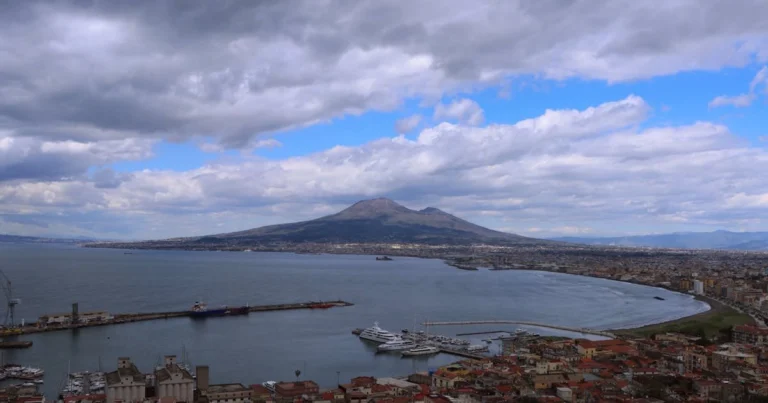
Pompeii lay downwind, south-east of the volcano. For many hours it received a rain of pumice and ash: enough to break roofs, but leaving many people time to escape. The pyroclastic flows came later.
Herculaneum, to the west and on the sea, received little pumice. Instead it was struck by pyroclastic flows, clouds of gas and ash at hundreds of degrees that covered it layer after layer. In the end the town lay under a blanket up to about twenty metres thick in places, which cooled into something as hard as rock. That is why the excavations sit so far below the modern town.
Wood, bread and books
That hot, compact material had an unexpected effect: it carbonised and sealed what was lost at Pompeii. At Herculaneum you can see wooden beams, doors, stairs, beds and cupboards; food, ropes and fabric survived too.
Above all, books survived. In the Villa of the Papyri, a large villa just outside the town, Bourbon excavators found hundreds of carbonised papyrus scrolls in the mid-eighteenth century: the only library of classical antiquity to have come down to us. Many of the texts are by the Epicurean philosopher Philodemus of Gadara.
For more than two centuries the scrolls were almost unreadable: opening them meant risking their destruction. Since 2023 an international project, the Vesuvius Challenge, has been reading them without unrolling them, using X-ray scans and artificial intelligence. The first word read from a still-closed scroll was *porphyras*, “purple”.
The boat sheds on the beach
For a long time very few victims had been found at Herculaneum, and it was thought that almost everyone had escaped. Then, from 1980, the excavations reached the ancient beach. In the fornici, the vaulted sheds where boats were kept, lay the remains of about three hundred people: families, children, people waiting for help from the sea that never came.
Studies of those bones have told us a great deal about life in the town: age, diet, illness, hard work. And about how death came: instantly, from the heat of the cloud.
Seeing both
Pompeii is large: it takes several hours and a lot of walking. Herculaneum is smaller and more compact, takes a couple of hours and still has the upper floors of its houses. Our advice is to see both and then climb the volcano that buried them: the Vesuvio Express shuttle leaves from Ercolano Scavi, the station for the excavations.